Stay Within the Law — and on Good Terms with Your Neighbours
The cheapest time to meet Ghana’s noise code is before a complaint reaches the EPA. The Environmental Protection Agency enforces ambient-noise limits under GS 1222:2018 and the EPA Act 1994 (Act 490) — residential areas are held to 55 dB(A) by day (06:00–22:00) and 48 dB(A) at night (22:00–06:00) — and the EPA and Accra Metropolitan Assembly have publicly warned churches, mosques, bars and nightclubs and deploy inspectors, notably over the festive season. Soundproof Ghana contains the sound at your venue so worship and events carry on at full spirit inside while the surrounding neighbourhood stays within limits. We measure what is leaving the building and design to bring it down to a compliant target. Book a free noise assessment: +233 20 531 3333.
Why Places of Worship and Venues Specify Soundproof Ghana
Containment is an engineering problem, not a matter of turning down the volume. Sound escapes through the weakest paths — single-glazed windows, un-sealed doors, roof and ventilation openings, and thin walls — so the fix is to raise the mass and sealing of the whole envelope and to close every flanking route. Low-frequency energy from sound systems and instruments is the hardest to contain and needs mass, decoupling and damping rather than a single thick layer. This is exactly the ground that foam suppliers and product pages do not cover; it needs a survey-and-install contractor.
We also solve the inside of the room, which venues often conflate with containment. A hard, echoey sanctuary or hall can be loud and unintelligible even to its own congregation; treating reverberation improves the listening experience while envelope work handles the neighbours. We diagnose which problem is which and design both to measured targets.
The Particular Requirements of Ghanaian Worship and Event Spaces
Worship and events are a defining Ghanaian vertical, and the venues are varied — from converted commercial units and open-sided structures to large purpose-built auditoria. Many operate late into the night in residential neighbourhoods, which is precisely where the 48 dB(A) night limit bites and where complaints originate. Ventilation is a real tension: sealing a building for containment can trap heat, so we design in acoustically treated ventilation and HVAC noise control so the space stays cool without opening an acoustic hole.
Materials must suit the climate. In humid coastal conditions we specify mould-resistant mineral-wool and PET-based systems and termite-treated or marine-grade timber, never open-cell foam as a durable solution. The aim is an honest, measured outcome: a venue that can run its full programme while demonstrably meeting the ambient limit at the boundary.
Recommended Services for Churches, Mosques & Venues
- Wall soundproofing — envelope mass, decoupling and sealing to contain music and voice within the building
- Commercial & venue acoustic fit-out — turnkey containment and internal acoustics for sanctuaries, prayer halls and auditoria
- Acoustic treatment & echo control — reverberation control for clear, intelligible speech and music inside the room
- HVAC noise control — acoustically treated ventilation so a sealed venue stays cool and quiet at once
Typical Venue Engagements
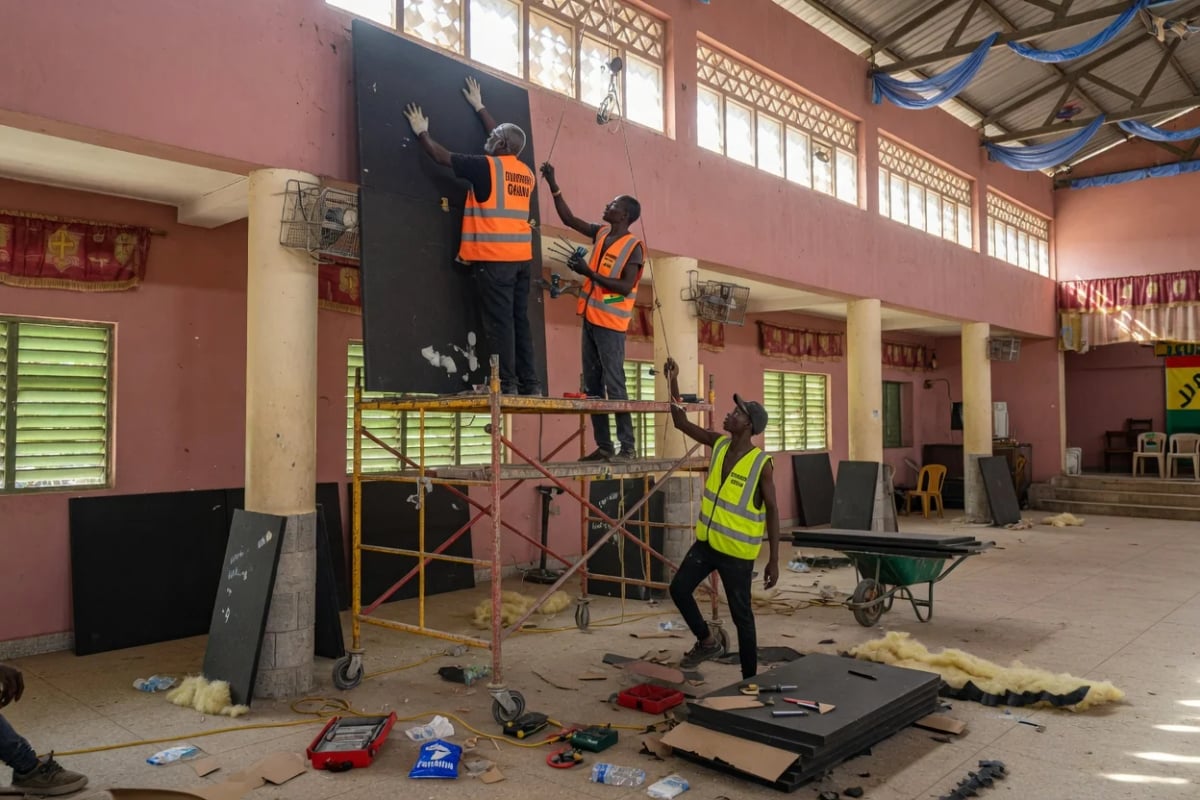
The most urgent brief is a venue already receiving complaints or facing EPA attention: here we survey the boundary noise, identify the escaping paths — usually windows, doors, roof and ventilation — and upgrade the envelope to bring night-time levels within the 48 dB(A) limit, verified with a meter.
A second pattern is the new or fitting-out venue that wants to get it right before opening, designing containment and internal acoustics together so it never becomes a nuisance case. A third is the intelligibility brief: an existing hall or sanctuary that sounds harsh and echoey, where reverberation treatment makes services clear and comfortable. In every engagement we commit to a measured, verifiable target at the boundary rather than an unrealistic promise of total silence.