The problem
Your room echoes — speech is hard to follow, calls sound hollow, and the space feels loud.
Our approach
Echo & Reverberation Control
Echo and reverberation controlled with acoustic absorption, baffles, and ceiling clouds — treatment that makes a room sound clear and calm, tuned to a measured reverberation target.
Our process
-
Assess
A free assessment establishes that the problem is reverberation inside the room — not sound leaking in from outside — and how the space is used.
-
Measure
We assess the room's reverberation and hard surfaces and set a target reverberation time appropriate to its purpose, whether speech clarity, calm, or recording.
-
Design
We design the right amount and placement of absorption — wall panels, baffles, and ceiling clouds — balanced so the room sounds natural, not dead.
-
Install
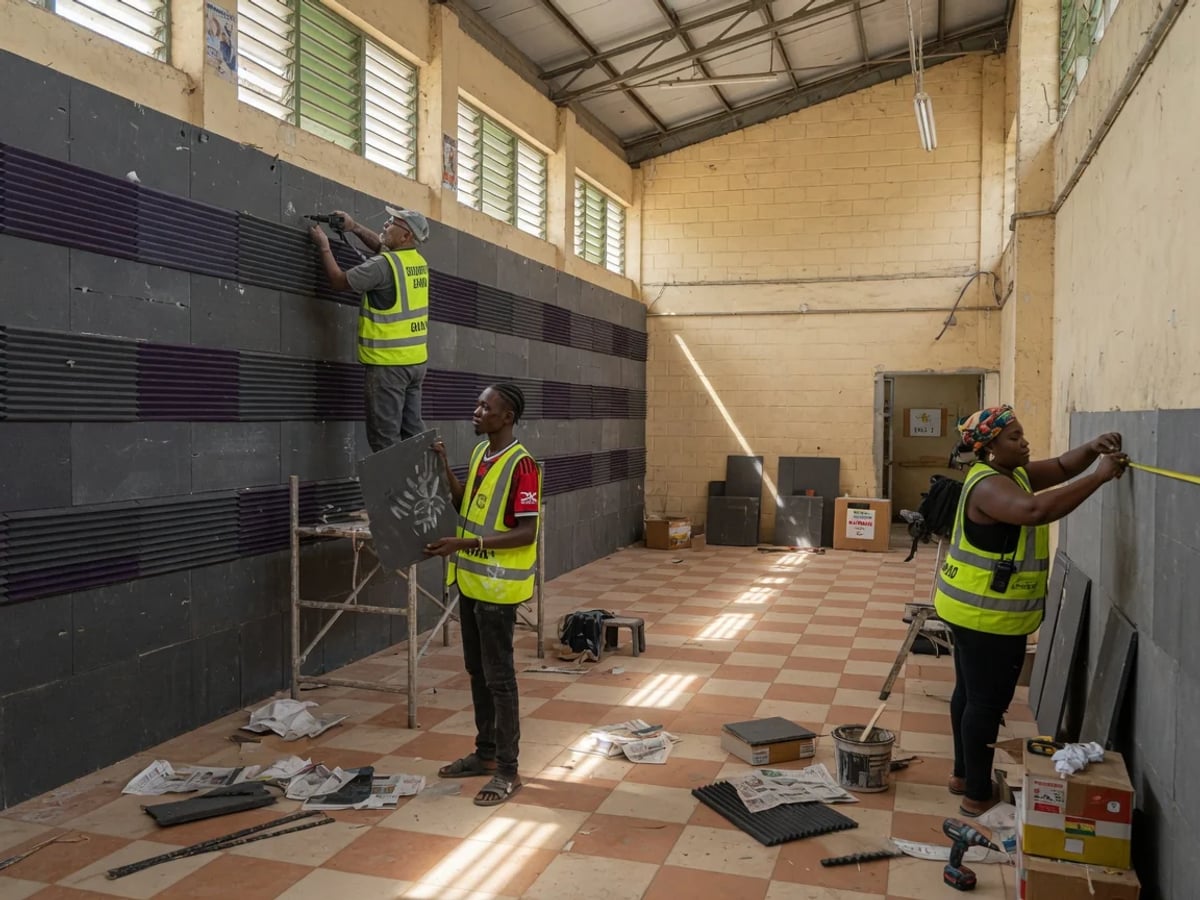
We install fabric-wrapped or PET absorbers and suspended elements using moisture- and mould-resistant materials suited to Ghana's humidity.
-
Verify
We assess the treated room against the target and confirm speech clarity, call quality, and comfort have improved.
The Challenge
A room that echoes is not a room with a soundproofing problem — it is a room with a treatment problem, and confusing the two is the single most common mistake we are called to correct. When speech is hard to follow, video calls sound hollow, a restaurant becomes a wall of noise, or a classroom’s teacher is lost in the din, the cause is reverberation: sound bouncing repeatedly off hard, reflective surfaces inside the room and taking too long to fade. The noise is not coming from next door or the street; it is your own room’s sound, reflected back at you again and again.
This distinction matters because the fix is the opposite of blocking. Blocking stops sound passing between rooms and uses mass and sealing; absorption soaks up sound inside a room and uses soft, porous materials. Foam and fabric panels — which do little to stop neighbour noise — are exactly the right tool here, because the job is to absorb reflections, not to seal a barrier. Many Ghanaian interiors are naturally reverberant: concrete, glass, tile, and plaster are all hard, reflective surfaces, and a room finished mostly in them will ring.
The goal is not to make the room dead and lifeless, which feels oppressive and unnatural, but to bring its reverberation time down to a level suited to how the room is used. A space for clear speech, a room for calm dining, and a room for recording each want a different amount of absorption — too little and it echoes, too much and it feels muffled and strange.
The Soundproof Ghana Solution
We treat echo as a measured tuning problem, not a matter of covering walls with as much foam as possible. First we confirm the issue really is reverberation inside the room, then we assess how long the room’s sound takes to fade and set a target reverberation time appropriate to its purpose — shorter for a studio or a busy restaurant, a little longer for a conversational space that should still feel alive. From there we calculate how much absorption the room needs and, just as importantly, where to place it.
The materials are chosen for both performance and Ghana’s climate. We favour fabric-wrapped mineral-wool panels and PET (polyester) acoustic panels, the latter inherently moisture- and mould-resistant and well suited to humid, tropical interiors — where bare open-cell foam absorbs moisture and can degrade. Depending on the space we use wall panels, suspended baffles, and ceiling clouds or islands, positioned at the first reflection points and across the hard surfaces that are ringing, while leaving the room looking considered rather than clad. For venues, restaurants, worship spaces, and offices we integrate the treatment into the interior design so it performs without dominating the room.
We commit to a measured improvement toward the agreed reverberation target, verified after installation, and to a room that sounds clear and comfortable rather than merely “covered in panels.”
Service Framework
- Free assessment confirming reverberation (not sound leaking in) is the problem
- Assessment of the room’s reverberation and a target reverberation time matched to its use
- Calculated quantity and placement of absorption — not simply “more panels”
- Fabric-wrapped mineral-wool and PET acoustic panels chosen for humid Ghanaian interiors
- Baffles, ceiling clouds, and islands where wall area alone is not enough
- First-reflection and hard-surface targeting for speech clarity and call quality
- Design integrated with the interior, verified against the target after installation
Typical Engagement
An echo-control engagement covers offices and meeting rooms where calls and conversations are hard to follow, restaurants and cafés fighting a wall of noise, classrooms and lecture halls where speech is lost, worship and event spaces that need clarity, and home offices set up for video calls. The work is typically quick, clean, and low-disruption — mounting panels and suspended elements rather than construction — and is often the most cost-effective acoustic improvement a space can make. Where a room needs both blocking and treatment, we scope them together and are clear about which problem each element solves.
Outcomes
- Reverberation reduced to a measured target, so speech is clear and calls no longer sound hollow
- The right tool for the actual problem — absorption for echo, not blocking for a room that never leaked
- A room that sounds natural and comfortable, not dead or muffled from over-treatment
- Humidity- and mould-resistant materials that keep performing in Ghana’s climate
- Treatment integrated with the interior, verified against the reverberation target
Book a free noise assessment: +233 20 531 3333.