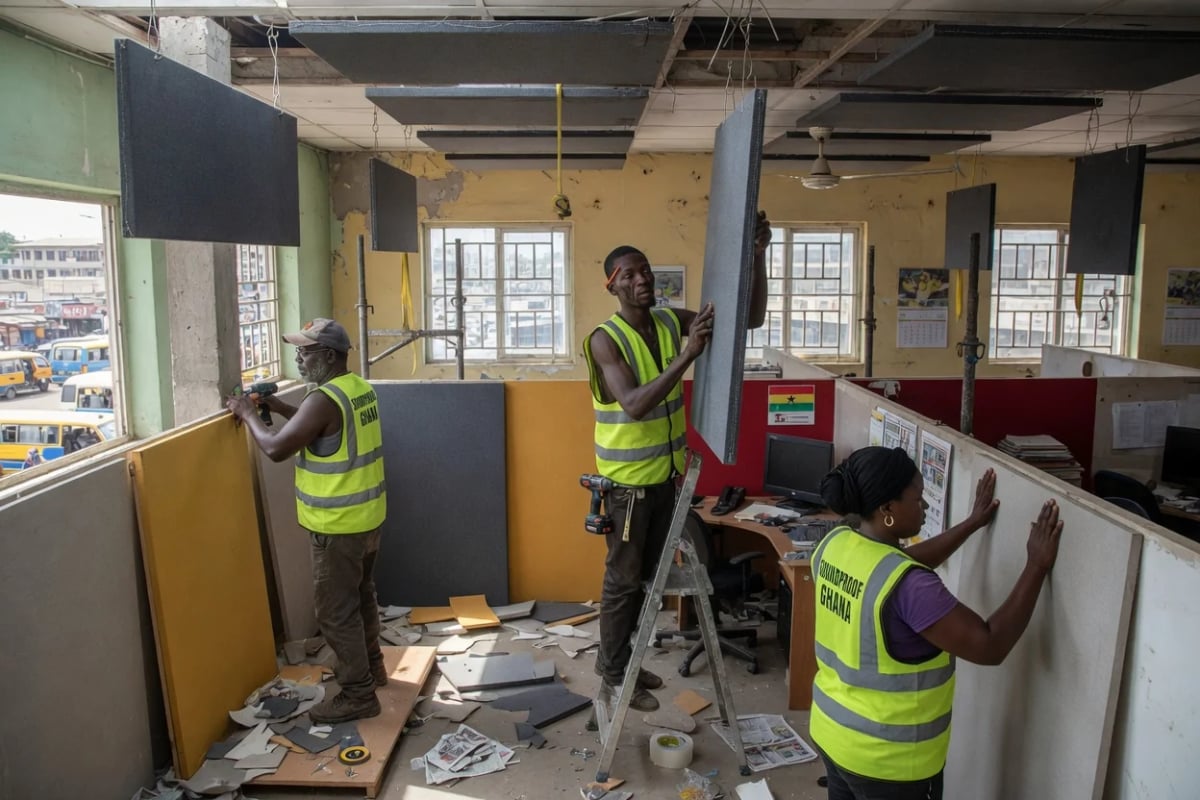
Protect Your Team’s Focus — and Their Conversations
One overheard conversation can cost the next 23 minutes: research by Professor Gloria Mark at UC Irvine found it takes on average around 23 minutes to fully refocus after an interruption, and it is intelligible speech, not sheer volume, that breaks concentration. Open-plan floors typically run at 60–65 dB, while focused work wants something closer to 40–55 dB. Soundproof Ghana treats an office on two fronts at once — cutting the reverberation that makes a floor feel chaotic, and raising speech privacy so a boardroom conversation or a client call stays where it belongs. We measure the actual acoustic conditions, set a target, and verify it after the work. Book a free noise assessment: +233 20 531 3333.
Why Employers and Fit-Out Teams Specify Soundproof Ghana
An office has two different acoustic problems that are easy to confuse. The first is reverberation — sound bouncing around a hard-surfaced room until the space feels loud and tiring; this is solved with absorption, not blocking. The second is transmission — a boardroom whose discussions carry into the corridor, or a partition that passes every call between rooms; this is solved with mass, sealing and, where privacy is the goal, electronic sound masking. Foam alone addresses neither properly. We diagnose which problem you actually have and design accordingly, so you are not paying for panels when you needed a sealed partition, or a wall when a masking system would have done the job.
As a survey-and-install contractor we work from measured RT60 and speech-privacy conditions rather than guesswork, and we coordinate cleanly with fit-out and interiors teams so acoustics are designed in, not bolted on afterwards at greater cost.
The Particular Requirements of the Ghanaian Workplace
Ghanaian commercial buildings are typically concrete-framed with hard finishes and open-plan layouts, which makes reverberation and cross-talk pronounced. Add a near-constant standby generator and often close-coupled HVAC, and the background noise floor climbs. GS 1222:2018 sets an office ambient guideline of 55 dB(A) day / 50 dB(A) night, which is a useful design anchor for a comfortable, private floor.
Speech privacy carries a compliance dimension too: where HR, legal, finance or client-confidential discussions happen, overheard conversations are not merely irritating but a genuine data and trust risk under Ghana’s Data Protection Act, 2012 (Act 843). The reliable fix is a system — blocking the partition, absorbing reflections, and adding a controlled masking sound so residual speech is no longer intelligible. In humid coastal offices we specify mould-resistant mineral-wool and PET-based treatments rather than foam, which degrades in sustained high humidity.
Recommended Services for Offices & Workplaces
- Acoustic treatment & echo control — absorption to bring reverberation down to a comfortable, intelligible level on open floors and in meeting rooms
- Sound masking & speech privacy — a tuned, low-level masking sound so confidential conversations are no longer intelligible across a floor
- Wall soundproofing — sealed, high-STC partitions for boardrooms, HR and executive offices
- Commercial & venue acoustic fit-out — turnkey design and installation coordinated with your interiors programme
Typical Office Engagements
The most common brief is the noisy open-plan floor: staff struggle to concentrate and calls are hard to follow. Here absorption to reduce reverberation, often with masking to lift speech privacy, transforms comfort and productivity — measured before and after so the improvement is demonstrable.
The boardroom brief is the second pattern: a conference or meeting room whose discussions must not carry, and which must also sound clear on video calls. This combines a sealed, mass-loaded partition with internal treatment for intelligibility. A third recurring engagement is the dedicated quiet zone or call booth — small, private, well-treated spaces carved into a busy floor for focused work and confidential calls. Throughout, we commit to a measured target and verify it, never to an unrealistic promise of total silence in a working office.