The problem
Traffic, horns, and street noise pour into your rooms through the windows and façade.
Our approach
Road & Traffic Noise Reduction
Exterior road and traffic noise reduced with acoustic secondary glazing and façade sealing — the highest-value path first, designed to a measured target and verified.
Our process
-
Assess
A free assessment identifies the weakest link between the street and your room — almost always the windows — and confirms whether the façade, vents, or doors also need attention.
-
Measure
We record the intrusive decibel level inside the room at the times that matter to you, and set a realistic interior target for sleep, focus, or business use.
-
Design
We design decoupled acoustic secondary glazing with a deep air cavity and high-performance seals, plus any façade or vent treatment the survey shows is needed.
-
Install
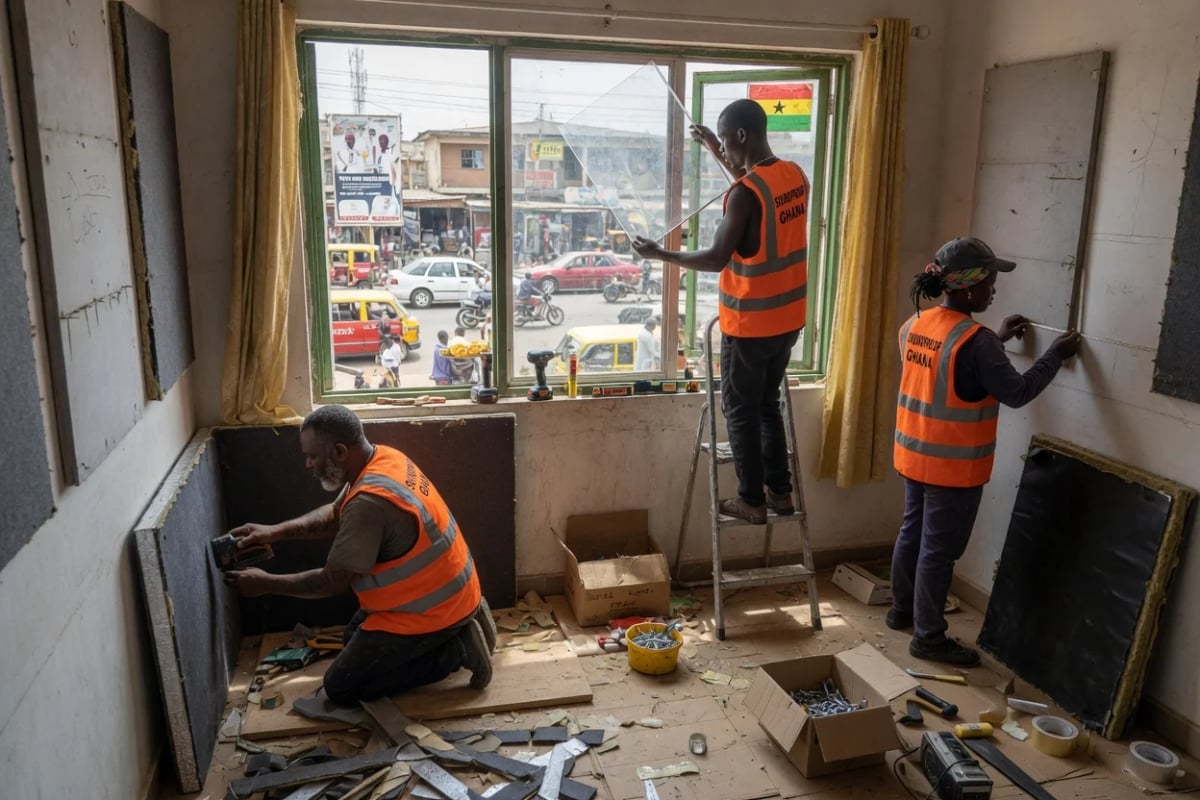
We install the secondary glazing and seal the perimeter, vents, and any gaps, using materials that stand up to Ghana's heat and humidity without warping or degrading.
-
Verify
We measure the interior level again after installation and document the before-and-after reduction against the target we agreed.
The Challenge
If your home or office sits on a main road, a trotro route, or a busy junction in Accra, Tema, or Kumasi, the noise arriving through your windows is a constant tax on rest and concentration. Traffic hum, horns, revving engines, and roadside trading carry a wide band of sound, and in most Ghanaian buildings the windows are the single weakest point in the wall — thin glass in frames that were chosen for cost and ventilation, not for keeping noise out.
This is airborne noise arriving from outside, and the physics are unforgiving: a wall might block sound well, but if the window beside it is a single pane in a leaky frame, the sound simply pours through the weakest opening. Sealing and glazing the window is therefore almost always the highest-value move — the point where a given budget buys the biggest measurable reduction. The World Health Organization’s Environmental Noise Guidelines (2018) recommend keeping night-time road-traffic noise low precisely because chronic exposure disturbs sleep; getting the bedroom envelope right is not a luxury, it is a health measure.
There is no product that makes a roadside room silent, and we will never claim one. But the difference between a single-pane window and a properly decoupled acoustic glazing system is large, measurable, and life-changing for anyone trying to sleep or work beside Ghana’s traffic.
The Soundproof Ghana Solution
Our first principle is to fix the weakest path first. In almost every road-noise case that means acoustic secondary glazing: an independent second pane installed inside your existing window, separated by a deep air cavity and sealed with high-performance perimeter seals. The decoupling — two masses separated by an air gap — blocks far more than a single thick pane could, because the air gap breaks the path the sound would otherwise travel straight through. We keep your existing window in place and add a second, tuned layer in front of it.
Where the survey shows the façade, trickle vents, roller-shutter boxes, or entrance doors are also leaking, we treat those in the same pass — because sealing the window while leaving an open vent beside it wastes much of the gain. We choose materials and seals that tolerate Ghana’s heat and sustained humidity, avoiding anything that warps, perishes, or grows mould in coastal conditions. Where ventilation matters, we design in acoustic venting so the room stays quiet without becoming stuffy — sealing a room and forgetting the air is a mistake we plan around from the start.
We commit to a measured interior target, not a promise of silence, and we verify it with before-and-after readings inside the room.
Service Framework
- Free assessment identifying the weakest street-to-room path and the interior noise target
- Interior decibel measurement at the hours that matter — night for bedrooms, working hours for offices
- Decoupled acoustic secondary glazing with a deep air cavity and high-performance seals
- Façade, trickle-vent, shutter-box, and entrance-door sealing where the survey requires it
- Acoustic ventilation designed in where sealing would otherwise reduce airflow
- Heat- and humidity-tolerant materials chosen for Ghanaian coastal conditions
- Before-and-after interior verification measurement against the agreed target
Typical Engagement
A road-noise engagement most often covers the street-facing rooms of a home — bedrooms first, then living rooms and home offices — or the frontage of a clinic, guesthouse, or office exposed to a busy road. Secondary glazing is typically installed quickly and cleanly, with little disruption, and can be phased room by room so the most sleep-critical spaces are done first. For larger commercial frontages we scope the whole exposed elevation, including doors and any ventilation openings, so the room is treated as a complete envelope rather than a single window.
Outcomes
- Intrusive road, horn, and street noise reduced to a measured interior target you can rest and work in
- The highest-value path treated first, so your budget buys the biggest audible improvement
- Bedrooms brought toward the low night-time levels recommended for undisturbed sleep
- Ventilation preserved by design, so a quieter room does not become a stuffy one
- A documented before-and-after decibel result inside the room
Book a free noise assessment: +233 20 531 3333.