The problem
Your standby generator's roar and drone disturb your home, neighbours, or business.
Our approach
Generator & Genset Noise Control
Standby-generator noise controlled at source with an acoustic enclosure, exhaust and intake silencers, and vibration isolation — then the wall and window path into occupied space.
Our process
-
Assess
A free site assessment locates the generator relative to the spaces it disturbs and identifies all three noise paths — the casing, the exhaust and intake, and the vibration travelling through the slab.
-
Measure
We measure the sound level at one metre from the set and at the boundary or window where it intrudes, and set a target that protects both your occupants and your neighbours.
-
Design
We design a ventilation-balanced acoustic enclosure or canopy, exhaust and intake silencers, and vibration isolation — sized so the set stays cool while the noise comes down.
-
Install
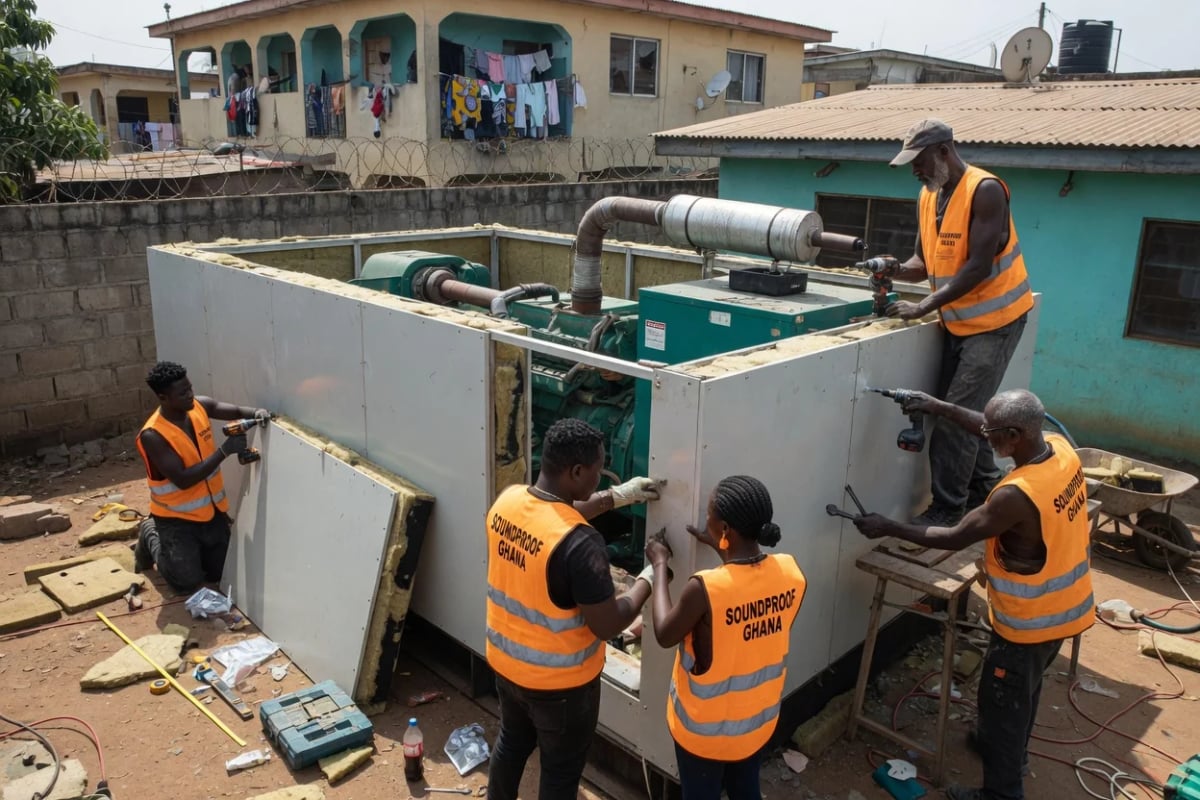
We fabricate and fit a steel-skin, mineral-wool-lined enclosure, install the silencers and anti-vibration mounts, and treat the wall or window path into any occupied room.
-
Verify
We re-measure at one metre and at the boundary, and document the before-and-after level against the target and Ghana's ambient limits.
The Challenge
Few noise problems are as distinctly Ghanaian as the standby generator. When the grid goes down, the genset keeps the home, clinic, office, or shop running — but its constant roar and low drone become the soundtrack of every outage, for you and for everyone around you. No international soundproofing supplier addresses this properly, because few markets rely on standby generation the way Ghana does. It is the noise problem we were built to solve.
Generator noise is not one problem but three, and treating only one leaves the others untouched. First, the casing noise radiating off the engine and alternator body. Second, the exhaust and intake noise — the pulsing roar from the exhaust and the air being drawn in for cooling and combustion. Third, the structure-borne vibration travelling out of the engine feet, through the slab or mounting, and re-radiating as a hum inside nearby rooms. A canopy alone that ignores the exhaust, or an enclosure that traps the heat, will either fail on noise or cook the machine. The engineering has to balance all three paths against the generator’s need for cooling airflow.
There is a compliance dimension too. Ghana’s ambient-noise limits under GS 1222:2018 — residential 55 dB(A) day and 48 dB(A) night, commercial 75/65 — are enforced by the EPA, and generator noise is exactly the kind of persistent nuisance that draws complaints. Bringing a genset within a defensible level is not only about comfort; it protects you from disputes with neighbours and regulators.
The Soundproof Ghana Solution
We treat all three paths in one coordinated design. The core is a ventilation-balanced acoustic enclosure or canopy — a steel outer skin lined with mineral wool behind a perforated inner face, built so cooling air still flows freely through acoustically treated intake and discharge attenuators. Generator canopies are conventionally lined with rockwool because it is non-organic, water-repellent, and holds up to heat and Ghana’s humidity where foam would degrade. On the exhaust, we fit a residential- or critical-grade silencer sized to the engine; on the intake and discharge, we use acoustic louvres and attenuators so the machine breathes without shouting.
For the vibration path, we mount the set on anti-vibration isolators or an inertia base so the hum never enters the slab in the first place — because once vibration is in the structure, no enclosure can stop it re-radiating inside the building. Finally, where the generator sits close to living or working rooms, we treat the wall and window path into those rooms as well: the same secondary glazing and wall build-up we use for road noise, applied to the side facing the set. Treating the source and the receiving room together is what turns a loud outage into a quiet one.
We do not promise silence — a running engine will always make some sound. We commit to a measured level at one metre and at your boundary, designed to sit within Ghana’s ambient limits, and we prove it with before-and-after readings.
Service Framework
- Free site assessment of generator position, cooling needs, and the three noise paths
- Sound measurement at one metre and at the affected boundary or window
- Ventilation-balanced acoustic enclosure or canopy: steel skin, mineral-wool lining, perforated inner face
- Exhaust silencer and acoustic intake/discharge attenuators sized to keep the set cool
- Anti-vibration mounts or inertia base to stop structure-borne hum entering the slab
- Wall and secondary-glazing treatment on the path into any nearby occupied room
- Design targeted to GS 1222:2018 ambient limits, with before-and-after verification
Typical Engagement
A generator engagement ranges from a single domestic standby set beside a bedroom wall to a commercial or industrial genset serving an office block, clinic, hotel, or factory in Accra, Tema, or Kumasi. For homes, the priority is usually the vibration hum and the wall the set sits against; for businesses, it is meeting the boundary limit so neighbours and the EPA have no cause for complaint. Enclosures are fabricated to the specific set and site — locally built and climate-tuned rather than a shipped-in generic canopy — and the cooling calculation is done up front so the machine is never starved of air.
Outcomes
- Generator roar, drone, and hum reduced to a measured target at one metre and at your boundary
- Cooling airflow preserved by design, so the set runs safely while it runs quietly
- Structure-borne vibration stopped at the mount, so nearby rooms lose the hum, not just the roar
- A defensible level against GS 1222:2018, protecting you from neighbour and EPA complaints
- A locally built, humidity- and heat-tuned enclosure, with a documented before-and-after result
Book a free noise assessment: +233 20 531 3333.