The problem
Conversations that should be private are overheard in the next room, corridor, or waiting area.
Our approach
Speech Privacy & Confidentiality
Overheard conversations solved with a three-part system — blocking, absorption, and sound masking — so consultations and meetings stay confidential, designed to a measured privacy target.
Our process
-
Assess
A free assessment identifies where speech is escaping — through the partition, over the ceiling, under the door, or through vents — and how confidential the space needs to be.
-
Measure
We assess how intelligible speech is in the adjacent space and set a privacy target, since it is the clarity of overheard words, not their volume, that matters.
-
Design
We design a combined system — partition and door upgrades to block, absorption to reduce carry, and sound masking to cover residual speech below the threshold of intelligibility.
-
Install
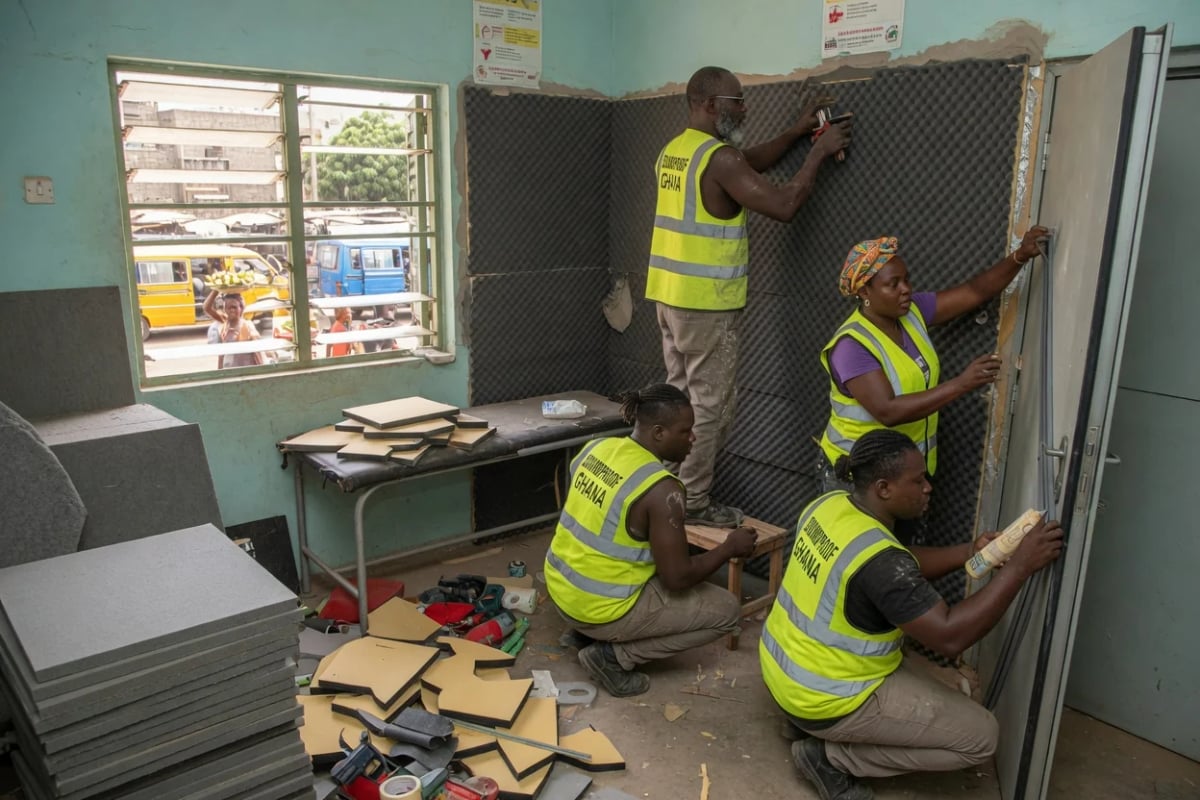
We seal and upgrade the partition, doors, and flanking paths, add absorption, and commission a sound-masking system tuned to the space.
-
Verify
We reassess speech intelligibility in the adjacent area and confirm confidential conversations are no longer clearly overheard.
The Challenge
Some conversations carry a duty of confidentiality — a doctor with a patient, a lawyer with a client, an HR manager with an employee, a boardroom weighing a decision. When those words can be made out in the next room, the corridor, or the waiting area, the failure is not merely awkward; it can be an ethical and legal problem. Under Ghana’s Data Protection Act, 2012 (Act 843) and the professional confidentiality duties of clinicians, lawyers, and advisers, keeping sensitive speech from being overheard is part of doing the job properly.
Speech privacy is misunderstood because people assume the fix is simply “more soundproofing.” In reality it depends on intelligibility, not volume — what breaks confidentiality is not how loud the neighbour hears you but whether they can make out your words. A conversation reduced to a faint, unintelligible murmur is private; the same conversation left just clear enough to follow is not, even at a low level. That is why privacy is a system with three parts, and leaving any one out undermines the whole.
The three parts are blocking (stopping speech passing through the partition, door, and flanking paths), absorption (reducing the reflections that carry speech), and sound masking (a low, engineered background sound that covers residual speech so words dissolve below the threshold of intelligibility). Consultation rooms, clinics, law offices, HR rooms, and boardrooms across Ghana routinely have thin partitions, hollow doors, ceilings that let sound over the top, and no masking at all — which is why sensitive conversations travel.
The Soundproof Ghana Solution
We design speech privacy as one coordinated system rather than a single product. First we find every path the speech is taking — often it is not only the partition but the door undercut, the gap over a partition that stops at the suspended ceiling, back-to-back sockets, or shared ductwork. Then we address the three parts together. For blocking, we upgrade and seal the partition and fit a properly sealed acoustic door, closing the flanking routes that let speech bypass an otherwise good wall. For absorption, we add treatment so the room does not amplify and carry speech in the first place.
For masking, we commission a sound-masking system — a network of emitters delivering a carefully shaped, low-level background sound (engineered, not random noise) that raises the privacy floor so any speech still leaking becomes unintelligible. Masking is the part almost every Ghanaian office and clinic is missing, and it is often what finally turns “we can nearly make out the words” into genuine confidentiality. All materials are chosen for humid conditions, favouring mineral-wool and moisture-resistant components over bare foam.
We commit to a measured privacy target — confidential speech reduced to unintelligible in the adjacent space — verified before and after, rather than an absolute promise that nothing at all can ever be heard.
Service Framework
- Free assessment of every speech path — partition, door, over-ceiling, sockets, and vents
- Assessment of speech intelligibility in the adjacent space and a defined privacy target
- Partition upgrades and sealing to block speech transmission through the wall
- Sealed acoustic doors and closure of door undercuts and flanking routes
- Absorption to reduce the reflections that carry and amplify speech
- Commissioned sound-masking system tuned to render residual speech unintelligible
- Humidity-appropriate materials, with before-and-after intelligibility verification
Typical Engagement
A speech-privacy engagement typically covers clinics and consultation rooms, law and accountancy offices, HR and interview rooms, banking and advisory booths, and boardrooms — anywhere in Accra, Tema, or Kumasi where confidential conversations must not carry to a waiting area or adjacent office. Work usually combines a partition and door upgrade with a masking installation, and can often be phased and completed with limited disruption to a working practice. For larger fit-outs we coordinate the masking design across a whole floor so privacy is consistent from room to room.
Outcomes
- Confidential conversations reduced to unintelligible in adjacent rooms, corridors, and waiting areas
- Privacy treated as intelligibility, not volume — the measure that actually protects confidentiality
- All three parts addressed — blocking, absorption, and masking — so the system does not fail at its weakest link
- Support for confidentiality duties under the Data Protection Act, 2012 and professional obligations
- A measured before-and-after privacy result across the treated spaces
Book a free noise assessment: +233 20 531 3333.