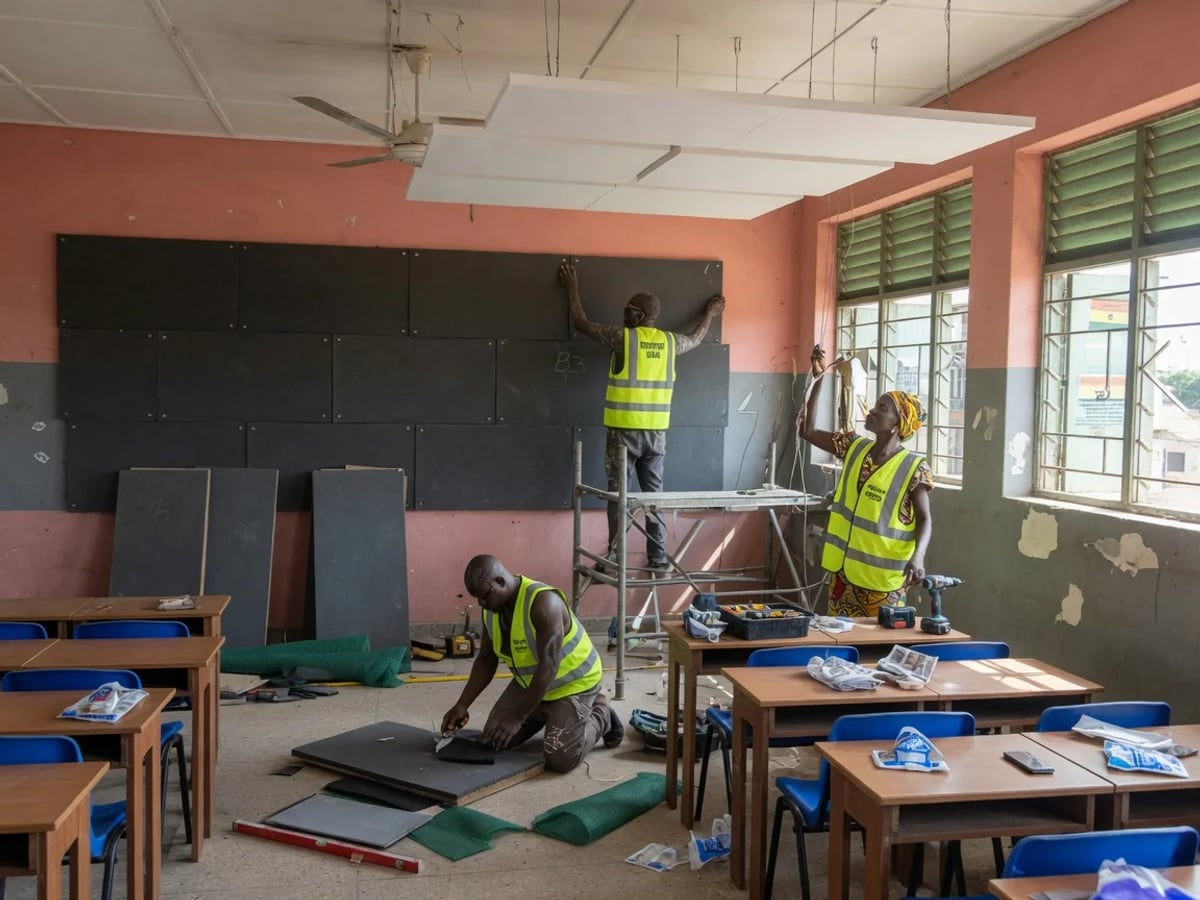
When a Room Echoes, Learners Miss the Lesson
Intelligibility is the whole point of a classroom, and reverberation is its enemy. In a hard, echoey room the tail of each word overlaps the next until speech blurs — hardest of all for younger children, second-language learners and anyone at the back. The fix is not volume but acoustics: bringing reverberation (RT60) down to a level where every word is clear. Soundproof Ghana treats classrooms, lecture theatres, halls and music rooms so speech carries clearly and noise between spaces is controlled, to targets we measure and verify. Book a free noise assessment: +233 20 531 3333.
Why Schools and Universities Specify Soundproof Ghana
Educational acoustics is mostly about controlling reflections inside a room, not blocking sound between buildings — a distinction that matters because the two problems are solved differently. A classroom that echoes needs absorption to shorten its reverberation so speech is intelligible; a music room that disturbs the class next door needs blocking — mass, decoupling and sealing — as well as internal treatment. Foam alone rarely delivers a balanced, durable result, and a school needs surfaces that are robust and cleanable. As a survey-and-install contractor we measure the actual room response and design the right balance of absorption and, where useful, diffusion.
We work to demonstrable outcomes: an RT60 target appropriate to the room’s size and use, verified after installation, so a school can show that its teaching spaces genuinely support clear communication rather than merely looking treated.
The Particular Requirements of Ghanaian Education Spaces
Ghanaian schools and lecture halls are typically concrete-framed with hard floors, block walls and large glazed openings — acoustically live rooms that echo and, when windows are open to the heat, admit traffic, generator and playground noise. Large multipurpose and assembly halls are the toughest: high volumes and hard surfaces make speech and music indistinct without careful treatment. GS 1222:2018 sets an education ambient guideline of 55 dB(A) day / 50 dB(A) night, a useful anchor for a suitable learning environment.
Durability and climate drive the specification. We use robust, mould- and moisture-resistant mineral-wool and PET/polyester systems that stand up to humid coastal conditions and the rigours of a school, rather than open-cell foam that degrades and cannot take handling. Music and band rooms additionally need impact and airborne isolation so practice does not disrupt neighbouring classes.
Recommended Services for Education & Schools
- Acoustic treatment & echo control — absorption tuned to an RT60 target for intelligible speech in classrooms, lecture theatres and halls
- Wall soundproofing — blocking between music rooms, examination rooms and teaching spaces that must stay quiet
- Ceiling & floor impact soundproofing — impact isolation for music rooms, halls and upper-floor teaching spaces
- Commercial & venue acoustic fit-out — turnkey acoustics for large assembly halls, auditoria and performance spaces
Typical Education Engagements
The most common brief is the echoey classroom or lecture hall where students at the back struggle to follow: absorption brings reverberation down to an intelligible target, measured before and after, so teaching is clearer and less tiring for staff and learners alike.
The large hall is the second pattern — an assembly or multipurpose space where speech and music are lost in echo, requiring a designed scheme of absorption and diffusion to make events intelligible. The third is the music or band room, which needs both internal treatment and isolation so practice does not carry into adjacent classes. In every engagement we commit to a measured, verified target rather than an unrealistic promise of total silence.