The problem
You can hear your neighbour's voices, TV, or music coming straight through the wall.
Our approach
Neighbour Noise Blocking
Airborne neighbour noise blocked at the wall with added mass, decoupling, and sealed flanking paths — designed to a measured target and verified before and after.
Our process
-
Assess
A free on-site noise assessment establishes what you are actually hearing — speech, television, or music — and traces every path it takes into your room, including the shared wall, doors, and flanking routes.
-
Measure
We record real sound levels in decibels on both sides of the partition and identify the dominant frequencies, so the design targets the noise you have rather than a generic assumption.
-
Design
We specify an engineered build-up — added mass, a decoupled layer, damping, and perimeter sealing — sized to a defined transmission-loss target for your wall and budget.
-
Install
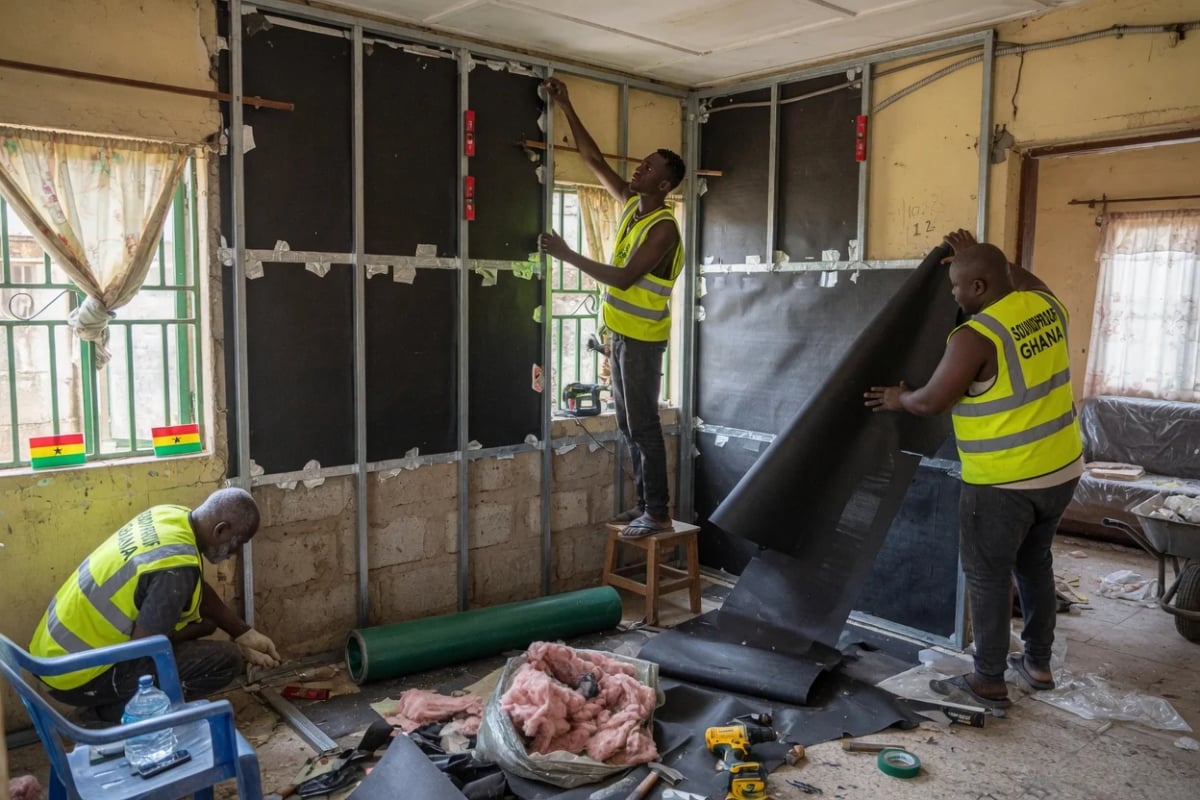
Our technicians install climate-appropriate materials — mineral-wool cores and moisture-resistant boards suited to Ghana's humidity — with airtight sealing at every junction, socket, and edge.
-
Verify
We measure again after installation and share the before-and-after decibel reading, so the improvement is documented rather than assumed.
The Challenge
Hearing your neighbour’s television, conversations, or Friday-night playlist through a shared wall is one of the most common complaints we are called to in Accra, Tema, and Kumasi — and one of the most misunderstood. Much of Ghana’s urban housing is built with single-leaf blockwork or thin partitions that were never designed to stop speech and music passing from one home to the next. In apartments, semi-detached houses, and compound homes, the wall between you and the next family is often the only thing separating two completely different daily rhythms.
The noise you are hearing is airborne sound: voices and audio travel through the air, strike the wall, vibrate it, and re-radiate into your room on the other side. Because it is airborne, the fix is not the same as stopping footsteps or vibration — it is a matter of adding mass, breaking the path the vibration travels, and sealing every gap the sound leaks through. A single one-percent gap around a socket, skirting, or door can undo a great deal of a wall’s performance, which is why sealing matters as much as the material itself.
The other common misunderstanding is that egg-crate foam or decorative panels will solve it. They will not. Foam absorbs echo inside your own room; it does almost nothing to block sound travelling between rooms. Blocking neighbour noise is the opposite job, and it needs a system built for transmission loss.
The Soundproof Ghana Solution
We treat a party wall as an engineering problem with a measured answer. First we identify what you are hearing and where it is getting through — often it is not only the wall itself but flanking paths: shared ceilings, back-to-back electrical sockets, door undercuts, or unsealed junctions. Then we design a build-up around the four pillars of soundproofing: mass to resist the sound, damping to kill the wall’s resonance, decoupling to break the vibration path, and absorption in the cavity to stop the gap from ringing.
In practice this usually means an independent or resilient-mounted layer added to your side of the wall, a mineral-wool cavity, a damped double-board build-up, and meticulous perimeter sealing. We favour mineral (stone) wool cores because they are non-organic, water-repellent, and hold their performance in Ghana’s humidity — unlike open-cell foam, which absorbs moisture and degrades in the sustained high relative humidity common on the coast. Every socket, skirting line, and edge is sealed, because the best wall in the world underperforms if the sound simply routes around it.
We never promise total silence. What we commit to is a measured reduction to an agreed target — typically bringing intrusive speech down to inaudible or comfortably below your background level — and we prove it with before-and-after decibel readings.
Service Framework
- Free on-site noise assessment and path diagnosis across the wall, ceiling, sockets, and doors
- Decibel measurement on both sides of the partition to set a realistic transmission-loss target
- Independent or resilient-channel decoupled wall build-up designed to that target
- Mineral-wool cavity fill and constrained-layer damping for low-frequency and speech control
- Airtight perimeter sealing of sockets, skirting, junctions, and door perimeters to close flanking paths
- Climate-appropriate materials selected for humidity, mould, and durability in Ghanaian conditions
- Before-and-after verification measurement with a documented result
Typical Engagement
A neighbour-noise engagement usually covers one or two rooms in a residential property — most often a bedroom, living room, or home office where the intrusion is disrupting sleep, focus, or family life. Work is frequently completed within a few days per room and can often be phased so you continue living in the home throughout. Where the party wall is shared with a business, church, or noisy compound, we scope the full path — including any door or window through which the same noise enters — so the whole route is addressed, not just the most obvious surface.
Outcomes
- Intrusive neighbour speech, television, and music reduced to a measured, agreed target rather than a vague “quieter”
- A documented before-and-after decibel result, so you can hear and see the difference
- Flanking paths closed, so the noise cannot simply route around the treated wall
- Durable, humidity-appropriate materials that hold their performance in Ghana’s climate
- Bedrooms and living spaces returned to a level that supports sleep, focus, and privacy
Book a free noise assessment: +233 20 531 3333.