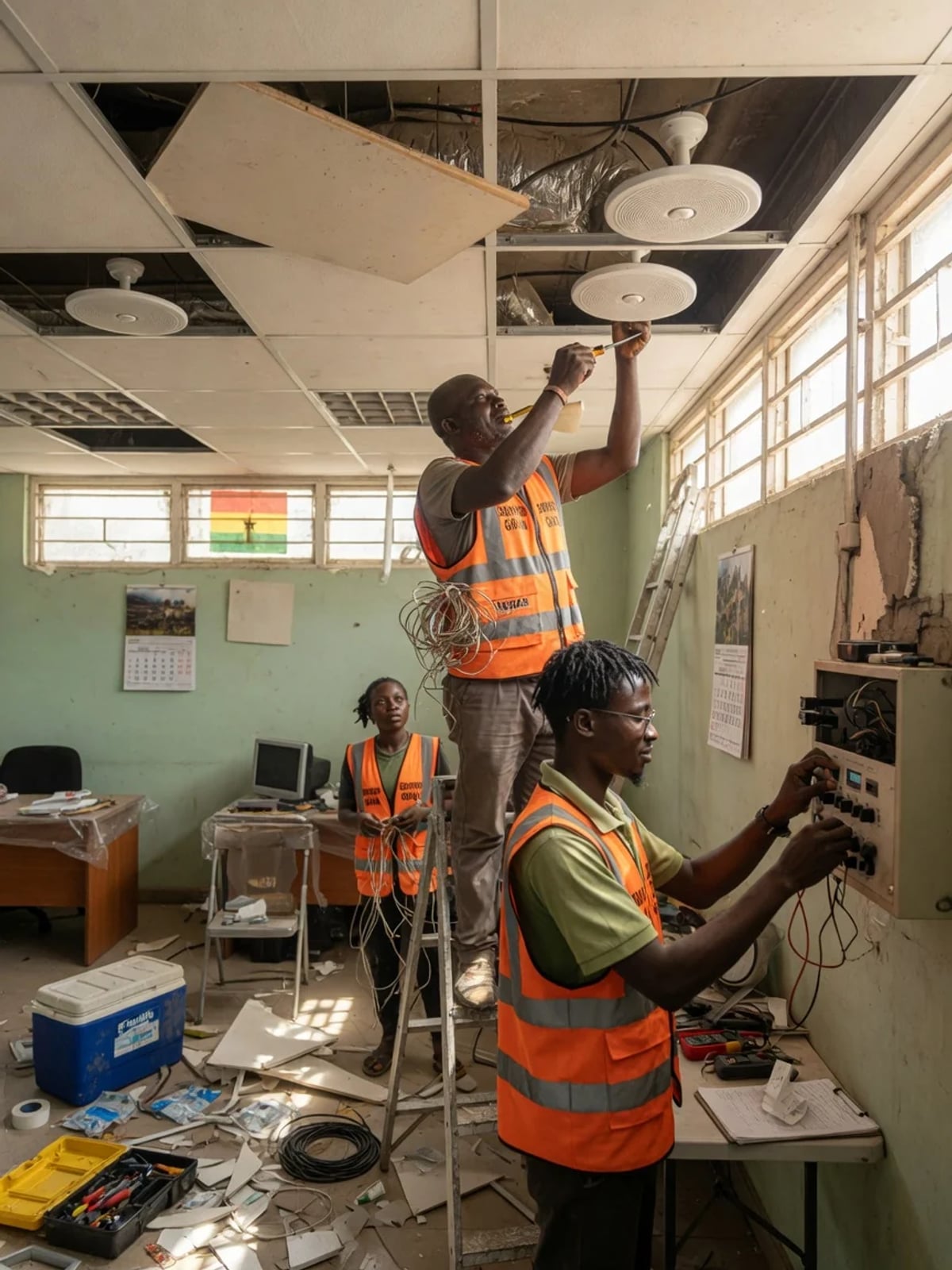
Sound Masking & Speech Privacy
Electronic pink-noise emitters combined with targeted absorption to raise the noise floor and stop confidential conversations carrying — engineered speech privacy for offices, clinics and banks across Greater Accra.
If the waiting room can hear the consultation, or the next desk can follow every call, you have a privacy problem that thicker walls alone will not solve. Sound masking raises the background noise floor by a precise, engineered amount so that speech stops being intelligible — verified at the listener’s position, not guessed at. Soundproof Ghana designs, installs and tunes masking systems for offices, clinics and banks across Greater Accra. Book a free noise assessment: +233 20 531 3333.
What Sound Masking Actually Is
Speech privacy is not about volume — it is about intelligibility. A conversation two desks away is rarely loud, yet you can follow every word because the background around you is quiet enough for that speech to stand out. Sound masking works on that gap directly: it adds a low, broadband, engineered background sound — a shaped pink-noise spectrum tuned to the frequency range of the human voice — so that stray speech blends into the background and stops being decipherable.
The comparison people reach for is a fan or “white noise”, but that is misleading. Uncalibrated white noise is hiss-heavy, uneven and quickly irritating. A properly engineered masking system is shaped to the voice, distributed uniformly through a space so there are no hot spots or dead zones, and set at a deliberately low level — typically just a few decibels above the natural noise floor. Set correctly, most occupants stop consciously hearing it within minutes while the privacy benefit remains.
Masking is one lever of three. On its own it lifts privacy meaningfully, but the strongest outcomes pair it with absorption (to stop reflections carrying speech across hard rooms) and partition sealing (to close the flanking paths above ceilings, under raised floors and around service penetrations where sound sneaks past a wall). We treat masking as a system, not a gadget.
When to Specify Sound Masking
Specify masking when confidentiality or concentration is being lost to speech that carries too easily. The clearest cases in Ghana are: open-plan offices and call centres where one overheard conversation breaks concentration; clinics and consulting rooms where patient confidentiality is an ethical and legal duty under the Data Protection Act, 2012 (Act 843); banking halls and financial services floors where account conversations must not be overheard at the next window; and reception, HR and boardroom zones where sensitive discussions sit close to circulation space.
It is also the right tool when construction is fixed. You cannot always rebuild a partition to the ceiling slab or add mass to a party wall in a live, tenanted office. Masking, absorption and sealing can be introduced into an occupied space with far less disruption than structural blocking — often out of hours, without closing the floor.
Our Method — Which Pillars We Use
Speech privacy is governed by the relationship between the signal (the speech you do not want overheard) and the noise floor (everything else). We move that relationship in your favour on three fronts at once.
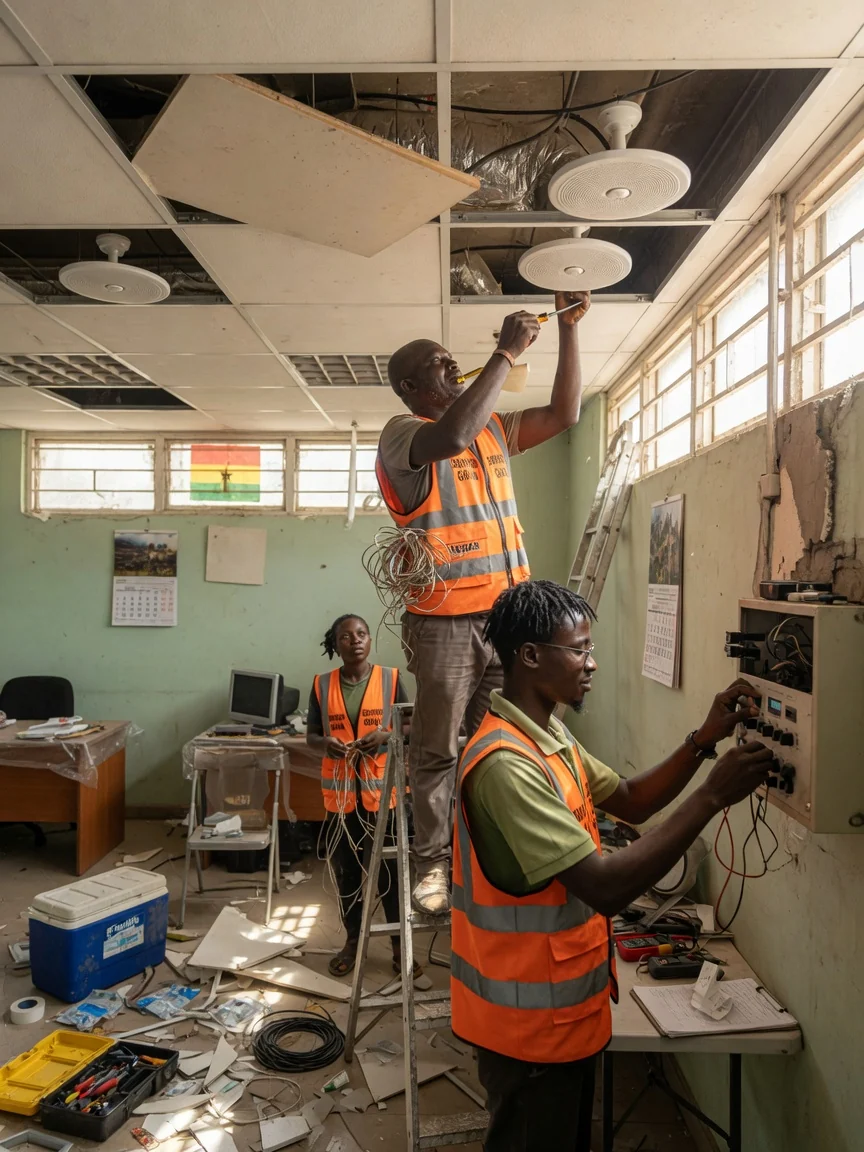
- Electronic masking (raise the floor): calibrated pink-noise emitters, installed in the ceiling void or as direct-field units where there is no accessible void, zoned by area and tuned to a spectrum that covers the voice without being intrusive.
- Absorption (cut the reflections): porous absorbers — mineral-wool-cored panels, ceiling rafts and baffles faced in moisture-resistant fabric or PET — reduce the reverberation that lets speech skate across hard-surfaced rooms. In humid coastal Accra and Tema we specify non-organic, mould-resistant cores rather than bare foam, which absorbs moisture and degrades.
- Partition sealing (close the flanking paths): we seal the gaps above suspended ceilings, around ducts and service penetrations, and at partition heads and junctions — the routes that let a “private” room leak regardless of how well the visible wall performs.


Typical Result Ranges
Because masking is measured at the listener, we describe outcomes in terms of intelligibility rather than a single decibel figure. A well-designed system typically lifts the background level by a modest, deliberate amount and, combined with absorption and sealing, moves conversations from “clearly followable” to “audible but unintelligible” at the target distance. In practical terms: the murmur remains, the words do not. We set that target with you at survey stage, and we verify it by re-measuring at the positions that matter — the next desk, the waiting room, the corridor — before we hand over.
Independent research is a useful frame here. Studies of interruption suggest it can take around 23 minutes to fully refocus after a distraction (Gloria Mark, UC Irvine), and workplace surveys suggest a majority of open-plan staff struggle to concentrate — which is why raising speech privacy is a productivity investment, not only a confidentiality one. We cite these as context, not as promises about your specific space.
Honest Boundaries
We will not tell you masking makes a room “100% soundproof” or silent — it does not, and any firm that claims it is overselling. Masking manages intelligibility; it does not block sound transmission through a wall the way mass and decoupling do. If your real problem is a generator next door or bass from an event space, masking is the wrong first tool and we will say so. Masking also cannot fix a partition with major structural leaks on its own — sealing has to come first. And it is a live-tuned system: the right level is the lowest one that achieves privacy, so we calibrate to your space rather than shipping a fixed setting. Everything we commit to is a measured target, verified before and after.
Related Services
Speech privacy is usually one layer of a wider acoustic strategy. These pair naturally with masking:
- Commercial & Venue Acoustic Fit-Out — turnkey design-build where privacy is engineered in from the start
- HVAC Noise Control — because a noisy AC or duct undermines any privacy scheme
- Vibration Isolation — structure-borne hum that masking cannot address