Occupational Noise Is a Liability You Can Engineer Away
Industrial noise is a measurable hazard with a measurable duty attached. The widely referenced OSHA action level of 85 dBA over an eight-hour time-weighted average is the threshold at which hearing-conservation obligations begin, and Ghana’s boundary limits under GS 1222:2018 hold light industry to 70 dB(A) day / 60 dB(A) night — so both worker exposure inside and noise emission at the fence are in scope. Soundproof Ghana reduces noise at the source with enclosures, silencers and vibration isolation, protecting workers and keeping you within limits, to targets we measure and verify. Book a free noise assessment: +233 20 531 3333.
Why Industrial Operators Specify Soundproof Ghana
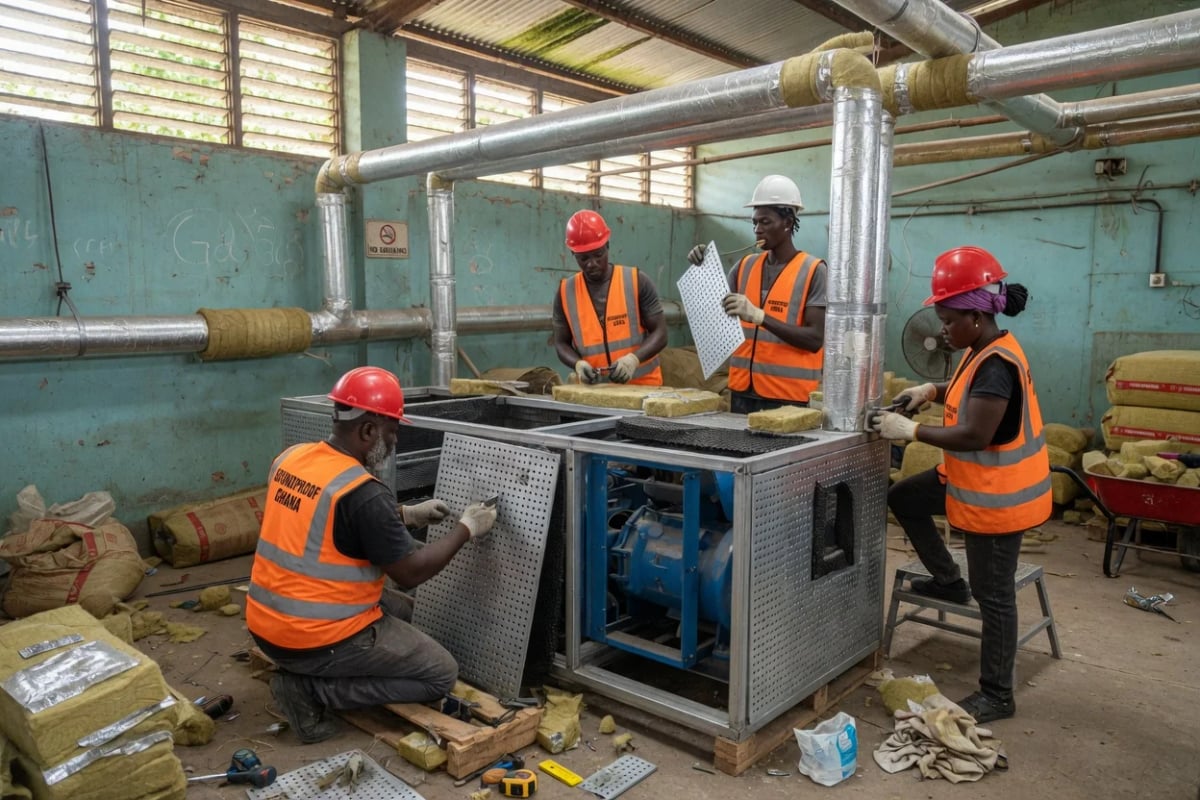
Effective industrial noise control follows a hierarchy: treat the source first, then the path, then the receiver. That means acoustic enclosures and canopies around the noisiest machines, silencers on exhausts, intakes and ductwork, vibration isolation so structure-borne energy does not radiate through the building, and lagging on pipes and ducts — engineering that a foam-panel supplier simply does not provide. As a survey-and-install contractor we measure exposure levels and boundary emissions, identify the dominant sources, and design enclosures and treatments that hit the target without starving machines of the ventilation and access they need.
Generators are the defining case. A standby genset can be the loudest thing on a site, and an acoustic enclosure — steel skin with a mineral-wool absorptive lining and balanced ventilation, conventionally around 50–75 mm of rockwool at high density with a perforated inner skin — can bring it down toward the 70–75 dB(A) at one metre range while keeping it cool. This is a Ghana-defining need that no import-and-ship supplier addresses.
The Particular Requirements of Ghanaian Industrial Sites
Ghana’s heavy reliance on standby generation makes genset noise the single most common industrial complaint, at the fence and inside occupied buildings alike. Plant rooms, compressors, pumps and HVAC add continuous background noise, and the mix of high heat loads with the need to seal for noise creates a real engineering tension — enclosures must ventilate and machines must stay serviceable.
Climate and durability govern materials. We specify mineral-wool (rockwool) linings, which are non-organic, water-repellent and mould-resistant and hold performance in humid conditions, behind perforated galvanised skins, and we use corrosion- and weather-appropriate steel for outdoor canopies in coastal Accra and Tema. Open-cell foam is unsuitable as a durable industrial solution. Every design balances attenuation against airflow, access and cooling so that noise falls without compromising the plant.
Recommended Services for Industrial & Plant Rooms
- Generator acoustic enclosures — ventilated, climate-tuned canopies and enclosures with exhaust and intake silencers to cut genset noise at the source
- Vibration isolation — isolation mounts and inertia bases so machines do not radiate structure-borne noise through the building
- HVAC noise control — duct silencers, plenum treatment and lagging for plant and mechanical systems
- Wall soundproofing — high-mass barriers and plant-room treatment where source control alone is not enough
Typical Industrial Engagements
The most common brief is the generator problem: a standby set that exceeds the boundary limit or exposes nearby workers, solved with a ventilated acoustic enclosure and exhaust silencing designed to a measured dB(A)-at-one-metre target while preserving cooling.
A second pattern is the plant or machine room where continuous equipment noise breaches occupational or boundary limits, addressed with source enclosures, vibration isolation and, where needed, room treatment. A third is the factory or workshop requiring a documented reduction in worker exposure toward the 85 dBA action level, where we survey exposures and apply the source-path-receiver hierarchy. In each case we commit to a measured, verified target rather than an unrealistic promise of silence around live machinery.