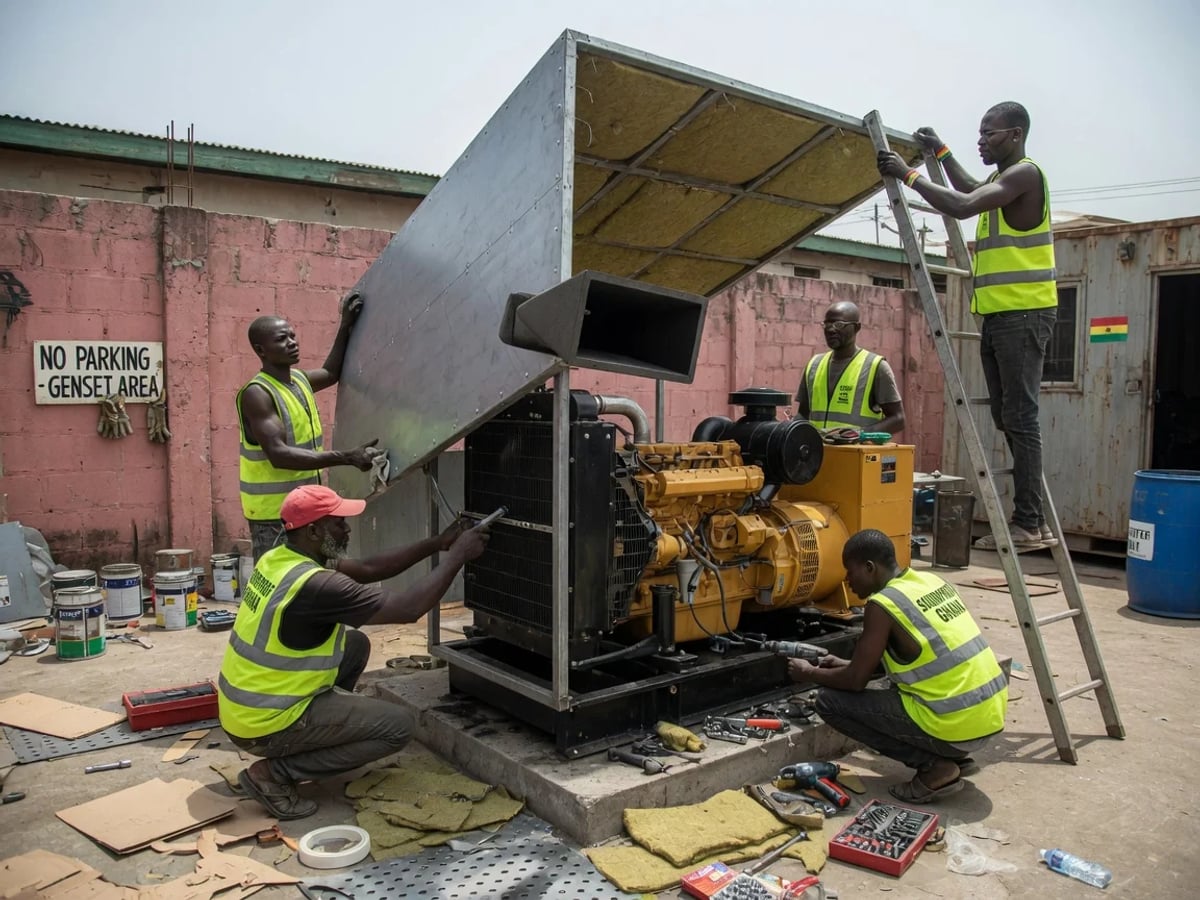
Generator Acoustic Enclosures
Locally-built acoustic canopies and enclosures for standby generators — exhaust and intake silencers, ventilation-balanced, engineered to a measured target of around 70–75 dBA at one metre. The Ghana genset-noise offer no competitor makes.
Ghana runs on standby generators — and the noise they make is one of the most common, least-addressed sources of complaints, sleepless nights and EPA exposure in the country. No international acoustics firm meaningfully addresses it, and there is no established local acoustic-enclosure fabricator. Soundproof Ghana builds acoustic enclosures and canopies for generators — surveyed, engineered to a measured target of around 70–75 dBA at one metre, ventilation-balanced so the engine never overheats, and verified at the boundary against the noise code. Book a free noise assessment: +233 20 531 3333.
Why This Is the Enclosure Nobody Else Builds
Search for a soundproofing solution in Ghana and you will find imported foam and product-supply models built for making a room sound nicer. None of them touches the problem that keeps Ghanaian neighbours, offices, clinics and hotels awake: the standby diesel generator that runs whenever the grid drops. Global acoustics brands ignore it because it is not their market; local suppliers ship foam sheets. The result is that most gensets in Accra, Tema and Kumasi sit either bare or under a generic canopy that was never tuned to the engine, the climate or the noise limit that applies at the site boundary.
That is the gap we were built to own. A generator enclosure is not a foam box — it is a piece of mechanical acoustic engineering that has to do two things that pull against each other: let cooling air through in the large volumes a diesel engine demands, while stopping the sound that wants to escape through those same openings. Get the balance wrong towards quiet and the engine overheats and shuts down; get it wrong towards cooling and the noise pours out. We engineer both at once, on site, for Ghanaian conditions.
What a Generator Acoustic Enclosure Is
An acoustic enclosure — sometimes a full walk-in enclosure, sometimes a close-fitting canopy — surrounds the generating set with sound-attenuating construction while managing the four things every genset produces: engine and casing noise (broadband mechanical roar), exhaust noise (the loud, low pulse from the tailpipe), cooling-air noise (fan and airflow through the intake and discharge openings), and vibration into whatever the set sits on. Each needs its own treatment; addressing only one leaves an obvious leak.
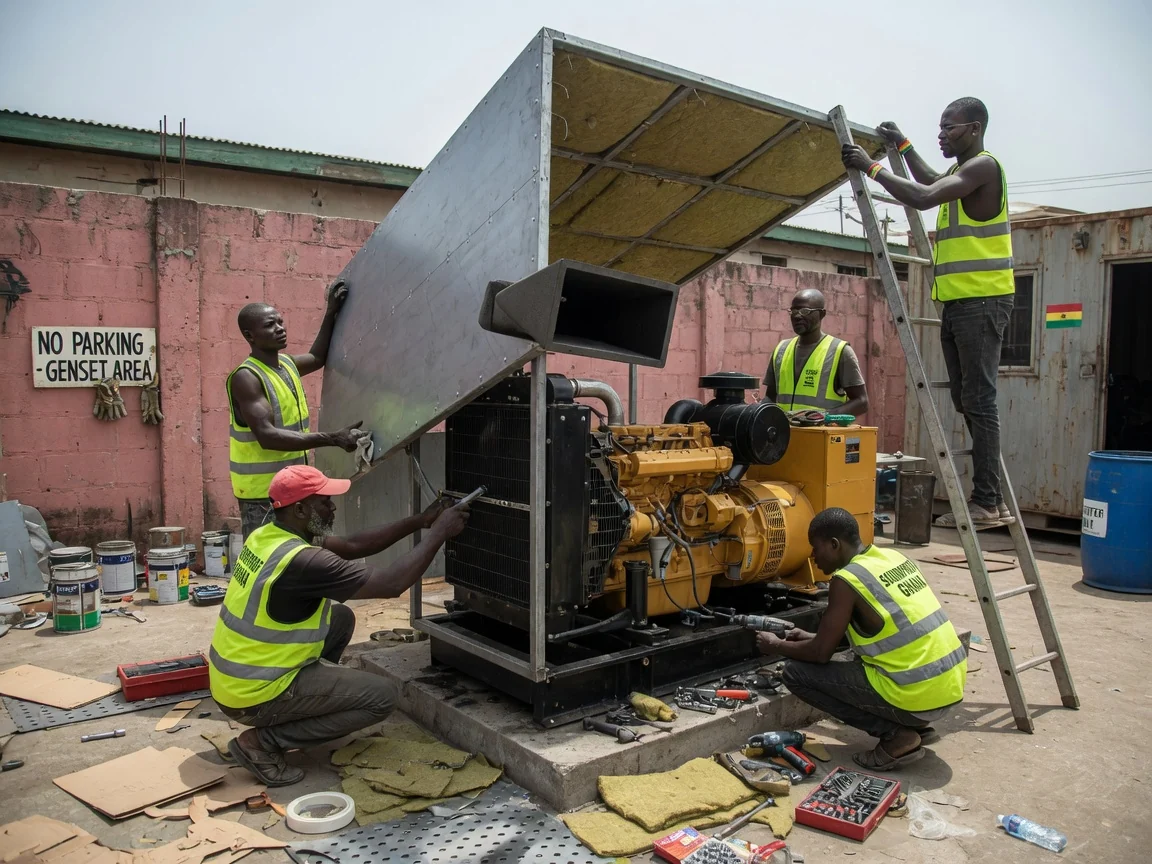
The enclosure walls are typically steel skins lined with 50–75 mm of acoustic-grade mineral wool at around 96 kg/m³, protected behind a perforated inner metal facing so the absorptive core is shielded but still soaks up engine noise. Mineral wool is the right core for Ghana: it is non-organic, water-repellent and mould-resistant, and it holds its performance in the humid coastal air of Accra and Tema where open-cell foam would absorb moisture, break down and foster mould within a couple of years. The exhaust gets a dedicated silencer matched to the engine’s size and back-pressure limit. The cooling openings get acoustic splitter-silencers — banks of absorptive baffles that air passes freely through while sound is attenuated.
When to Specify a Generator Enclosure
Specify one whenever a genset sits close to people who need quiet or to a boundary the noise crosses. The clear Ghana cases are: residential and estate generators disturbing the owner’s own bedrooms and the neighbours’, often at night when the EPA night limit is strictest; office, bank and data-centre standby sets whose run-time overlaps the working day; hospital and clinic generators where wards and consult rooms need calm; hotel and hospitality gensets where guest complaints and reviews are at stake; and industrial and plant sites in Tema and the port zone where multiple large sets and occupational noise limits apply. If EPA inspectors have visited, or complaints have started, the enclosure is usually the most direct route back into compliance.
Our Method — Which Pillars We Use
A generator enclosure combines every acoustic pillar because a genset produces every kind of noise at once.
- Mass & absorption (the enclosure shell): acoustic-lined steel panels — mineral-wool core behind perforated facing — block and absorb the broadband engine roar. Panel joints and door seals are detailed so there is no flanking leak around the box.
- Exhaust silencing: a residential or critical-grade exhaust silencer sized to the engine attenuates the loud low-frequency pulse from the tailpipe — often the single loudest component, and the one bare sets leave completely untreated.
- Ventilation-balanced acoustic airflow: acoustic intake and discharge splitter-silencers pass the full cooling-air volume the engine needs while attenuating the sound that would otherwise escape through the openings. This is the discipline that separates a working enclosure from one that cooks the engine.
- Decoupling (vibration isolation): where the set sits on a slab near occupied rooms, anti-vibration mounts and, if needed, an inertia base stop structure-borne hum bypassing the airborne treatment and re-radiating indoors.


Typical Result Ranges
A properly engineered enclosure typically brings a bare generator down to a measured target of around 70–75 dBA at one metre, and — the number that actually protects you — down to the limit that applies at your site boundary. Under Ghana Standard GS 1222:2018, EPA-enforced, the ambient limits are 55 dBA day (06:00–22:00) and 48 dBA night (22:00–06:00) for residential areas, and 75/65 dBA for commercial areas; night is the strict test for most estate and residential sets. We design and verify against whichever limit applies at your boundary, not just the headline one-metre figure, because it is the boundary level that EPA inspectors and neighbours actually respond to.
We express the outcome as a measured before-and-after, taken with the set under load, because that is the only honest way to state it. The exact reduction depends on the engine, the exhaust arrangement and how close the nearest receiver is — all of which we capture at survey before we quote.
Honest Boundaries
A running diesel engine is a powerful noise source, so we do not promise silence — we promise a specific, measured reduction to an agreed target and to the applicable boundary limit, verified under load before and after. Cooling is non-negotiable: we will never seal an engine in without a balanced acoustic ventilation path, because an overheating shutdown is worse than the noise. If the genset also transmits a hum through the slab into rooms below, that is a vibration problem we address alongside the enclosure, not one the enclosure alone fixes. And the enclosure has to be maintained — access panels and silencers kept sealed and clear — for the verified result to hold over time. Everything we commit to is a number we can measure, not a claim we cannot.
Related Services
A generator is a mechanical-noise system, and enclosing it often pairs with:
- HVAC Noise Control — the same silencer and airflow-attenuation discipline applied to ducts and plant
- Vibration Isolation — stop the genset’s structure-borne hum reaching rooms below
- Commercial & Venue Acoustic Fit-Out — where the plant and the building it serves are engineered together
- Sound Masking & Speech Privacy — for the offices the standby set protects