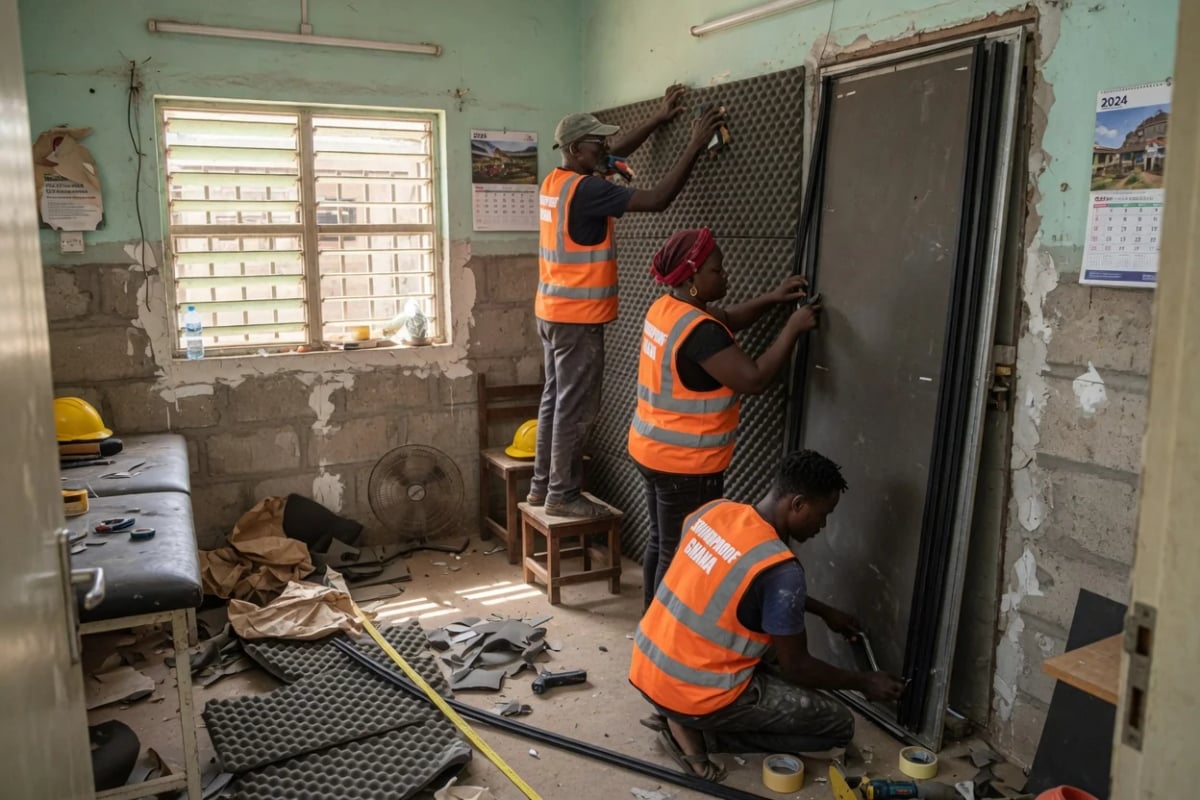
If the Waiting Room Can Hear the Consultation, You Have a Problem
Speech privacy in a clinic is not a comfort issue — it is an ethical and legal duty. When a consultation can be overheard from the waiting room or the next door, patient confidentiality is breached, and Ghana’s Data Protection Act, 2012 (Act 843), together with professional confidentiality obligations, makes that a genuine risk rather than a nicety. Privacy cannot be retrofitted after a complaint. Soundproof Ghana delivers it as a system — blocking the partition, sealing the door, absorbing reflections and, where needed, adding a controlled masking sound so residual speech is no longer intelligible — all to targets we measure and verify. Book a free noise assessment: +233 20 531 3333.
Why Clinics and Hospitals Specify Soundproof Ghana
Confidential speech privacy is achieved by a combination, never a single product. Blocking raises the partition and door so less sound gets through; absorption reduces reflections that carry voices; and sound masking adds a low, engineered background sound that renders any remaining speech unintelligible without being intrusive. Foam panels do none of the blocking and only part of the absorption — a sponge on the wall never sealed the lid. This is why speech privacy needs a survey-and-install contractor who measures the actual leakage and designs the whole chain.
We also handle the calm side of healthcare acoustics: hard-surfaced waiting areas and corridors that echo and amplify stress, where absorption creates a quieter, more reassuring environment. Every solution is designed to a measured target and verified, so you can demonstrate that a room genuinely protects what is said inside it.
The Particular Requirements of Ghanaian Healthcare Spaces
Clinics and hospitals in Ghana are typically concrete-built with hard, wipe-clean finishes chosen for hygiene — exactly the surfaces that reflect sound and carry voices. Consultation and examination rooms often sit directly off busy waiting areas, so the partition, and above all the door and its seals, decide whether a conversation stays private; a one-percent unsealed gap around a door can cost the better part of ten decibels. GS 1222:2018 sets a health-facility ambient guideline of 55 dB(A) day / 50 dB(A) night, a useful anchor for a calm environment.
Materials must respect both hygiene and climate. In humid coastal Accra and Tema we specify mould-resistant mineral-wool and PET/polyester systems behind cleanable, moisture-resistant facings, avoiding open-cell foam that harbours moisture and degrades — unacceptable in a clinical setting. The result is durable, hygienic acoustic performance rather than a finish that fails or fouls.
Recommended Services for Healthcare & Clinics
- Sound masking & speech privacy — a tuned, low-level masking sound so consultations cannot be understood from waiting areas or adjacent rooms
- Wall soundproofing — sealed, high-STC partitions between consultation rooms, offices and waiting areas
- Soundproof doors & seals — engineered door sets and perimeter seals, the decisive element for a private consultation room
- Acoustic treatment & echo control — absorption for calmer, quieter waiting areas and corridors
Typical Healthcare Engagements
The most common brief is the consultation or examination room where conversations carry: here we upgrade the partition and door, add absorption, and where the layout demands it introduce masking into the adjacent waiting area, verifying that speech is no longer intelligible outside the room.
A second pattern is the counselling, therapy or HR/records space with a higher confidentiality bar, treated as a complete privacy system. A third is the waiting area or corridor that echoes and feels stressful, where absorption brings the space to a calmer level. In every engagement we commit to a measured, verified target — demonstrable privacy — rather than an unrealistic promise of a totally soundproof room.