Give Your Family Back Its Sleep
If a generator two houses down, a busy roadside, or a neighbour’s late-night sound system is stealing your rest, the fix is not thicker curtains or a wall of foam — it is a properly engineered acoustic envelope for the rooms that matter. Your body treats noise as a threat even while you sleep: the World Health Organization’s 2018 Environmental Noise Guidelines recommend keeping night-time road-traffic noise below roughly 45 dB Lnight precisely because disturbed sleep drives the stress response whether you wake or not. Soundproof Ghana measures the actual noise reaching your bedroom, finds every path it uses, and builds the mass, decoupling and sealing needed to bring it down to a target you can sleep through. Book a free noise assessment: +233 20 531 3333.
Why Homeowners Specify Soundproof Ghana
Most homes in Accra, Tema and Kumasi are built in a way that carries sound easily — concrete blockwork transmits impact readily, thin partitions pass voices, and single-glazed louvres or sliding windows are the weakest link in the whole envelope. Foam panels sold online do not solve this; a sponge on the wall never sealed the lid. Real quiet comes from the four acoustic pillars working together — mass to block, damping to kill vibration, decoupling to break the path, and sealing to close every gap — because even a one-percent unsealed gap around a door or window can cost you the better part of ten decibels.
We are a genuine survey-and-install contractor, not an import-and-ship product page. We come to your home, measure with a sound-level meter, identify whether the intrusion is airborne (voices, traffic, a generator) or impact (footsteps from a flat above), and design only what the problem actually needs. You are never sold a wall you did not require, and we tell you honestly where a modest secondary-glazing job will transform a bedroom versus where a whole-envelope build is warranted.
The Particular Requirements of the Ghanaian Home
Ghana’s noise mix is specific, and so are its material demands. Standby generators are near-universal and are usually the single loudest source at a residence — treating the genset at the machine is far more effective than fighting its noise room by room. Roadside horns, neighbouring churches, spots and mosques, rain on metal roofing, and an air-conditioning compressor sitting a metre from a bedroom window all add to the load.
The coastal humidity of Accra and Tema also dictates what we install. Sustained relative humidity above roughly 60–70% is ideal for mould, so open-cell acoustic foam — which absorbs airborne moisture and degrades within a couple of years — is never positioned as a durable solution here. We specify moisture- and mould-resistant mineral-wool cores, PET/polyester finishes, and termite-treated or marine-grade timber so the work lasts in a tropical climate. Ghana’s ambient-noise standard, GS 1222:2018, sets residential limits of 55 dB(A) by day and 48 dB(A) at night, and we design your interior target with those figures in mind.
Recommended Services for Residential Homes
- Acoustic windows & secondary glazing — usually the highest-value fix for road, generator and street noise, adding a decoupled second pane with deep-cavity sealing
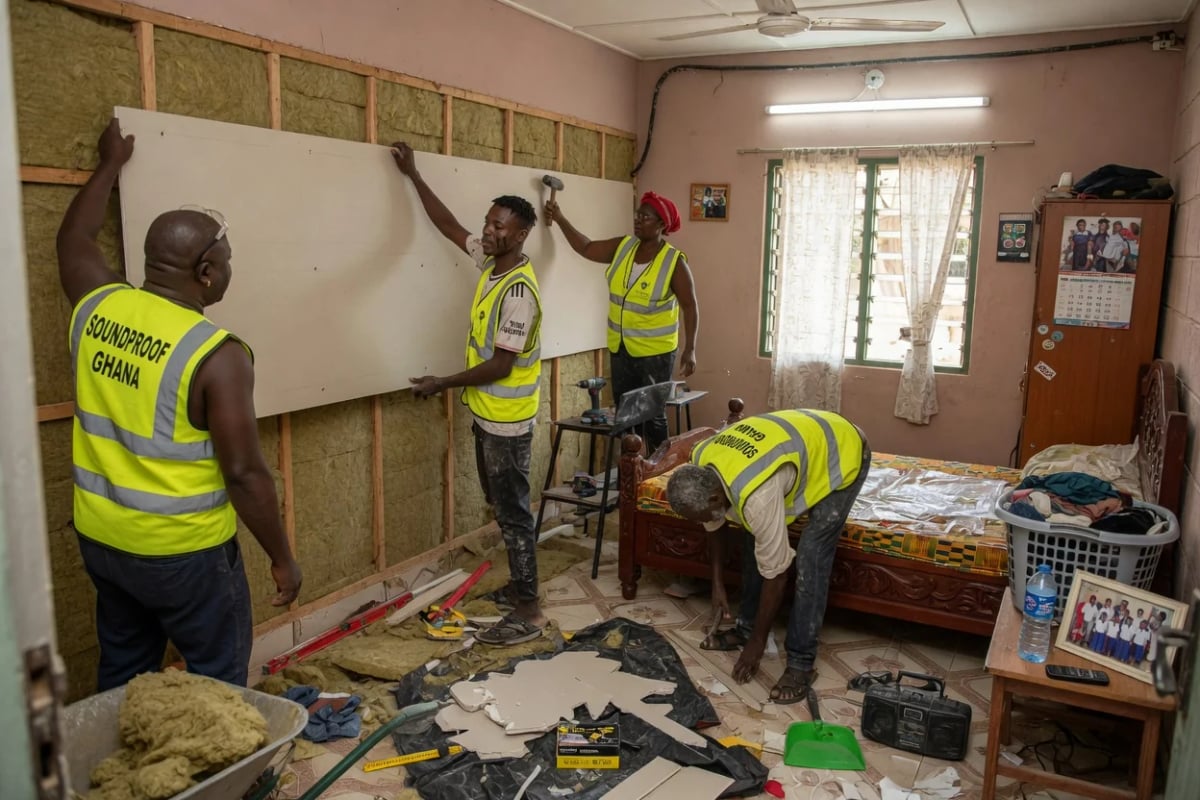
- Wall soundproofing — mass, decoupling and damping for party walls and rooms facing the source
- Soundproof doors & seals — engineered door sets and perimeter seals that stop sound sneaking around the barrier
- Generator acoustic enclosures — treating the noisiest source at the machine, the most Ghana-specific and often the most impactful single step
Typical Residential Engagements
The most common request is a sleep-critical bedroom: a shift worker, a young family, or an owner beside a busy road who needs the room to reach a night-quiet interior level. Here the envelope — windows, door and the wall facing the source — is upgraded and verified before-and-after with a meter so you can hear and see the difference.
A second frequent engagement is the generator problem: a home whose standby set dominates the compound is best solved with an acoustic enclosure at the source, sometimes paired with treatment of the window nearest the machine. Apartments and gated residences bring a third pattern — party-wall and floor/ceiling isolation between units, where a neighbour’s voices or footsteps carry through shared structure. In every case we commit to a measured target and verify it, rather than promising a “totally silent” room that physics cannot deliver.